
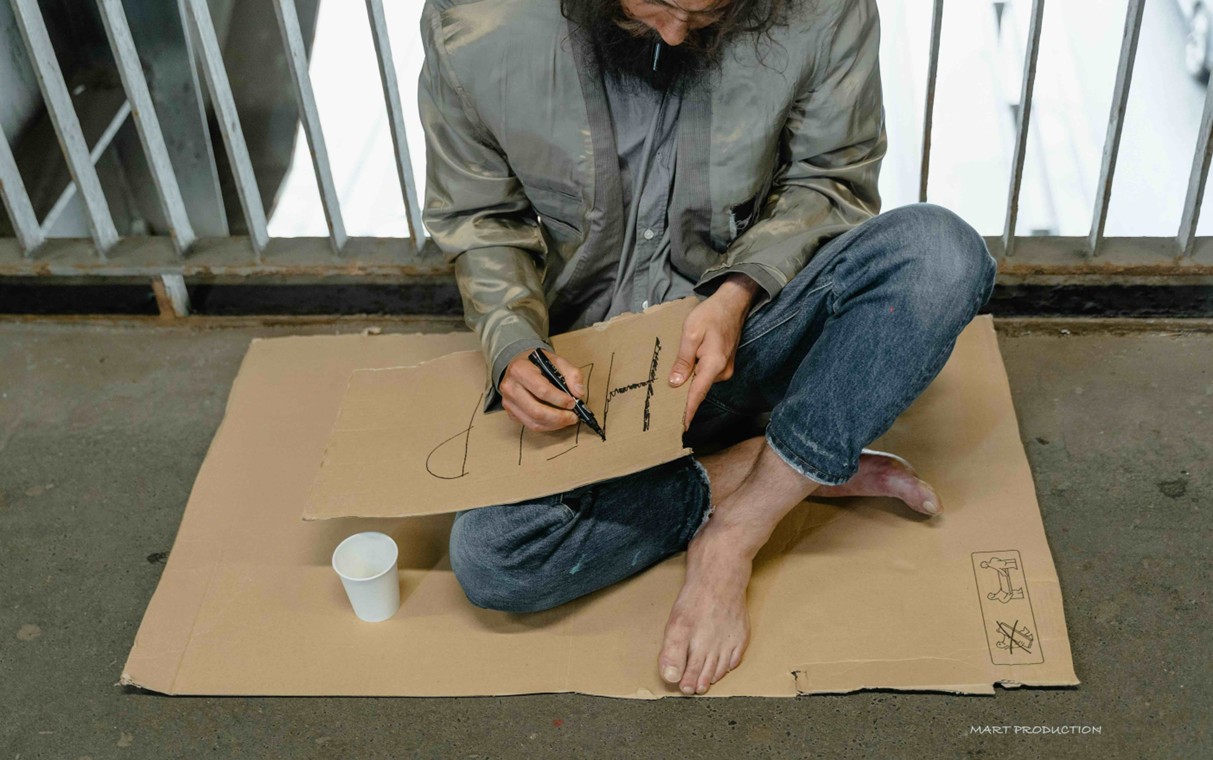
It happens to all of us. We’re exiting off the interstate and see someone with a sign at the end of the ramp, asking for money. Sometimes we roll down our window and offer a small donation. Most of us, most of the time, ignore them. After all, we’re almost always in a hurry to get somewhere else. And if we’re on the off-ramp, we’re probably getting close to our destination.
Before we ask why we hurry, we need to be honest about who is sitting on the side of the road. Not necessarily, at the end of an exit ramp. Rather, figuratively speaking, who is living on the margins and could use some help?
I’m talking about the family that can’t keep up with their utility bills and wonders how long the lights will stay on. It’s the person who cannot afford stable shelter and doesn’t know where they will sleep next week. It’s the household stretching groceries, trying to make something healthy out of almost nothing. It’s the neighbor who needs medical care but cannot afford to see a doctor.
These are not statistics. These are our neighbors.
And while none of this is new, the strain has grown. Over the past year, more people have found themselves living on that edge—closer to the roadside than they ever expected to be. The gap between stability and crisis has narrowed, and for many, it takes very little to fall from one into the other.
A big part of the problem is that support has been reduced. Funding has been cut back. Programs have been limited. Safety nets have been stretched thinner than they were before. And when that happens, people don’t disappear. They don’t simply figure it out. They move further to the side of the road.
We are often told there are reasons for this. We need to prioritize security. That we have to protect what’s ours. That resources are limited, and difficult decisions must be made. On the surface, that can sound reasonable. It can even sound responsible.
But we should at least pause long enough to ask what kind of decisions we are making—and who bears the cost of them.
Because when a nation chooses to invest more heavily in power, in dominance, in the economics of war, while at the same time withdrawing support from those in need, that is not simply strategy. It is a moral decision. And the cost of that decision is not theoretical. It is carried by people—people who find themselves pushed further and further to the margins.
As Christians, we talk a lot about sin, and too often our focus is on behavior that we don’t agree with. But when we speak of sin in a moment like this, we are not talking about one person’s behavior or one leader’s character. We are talking about something deeper. A pattern. A direction. A way of ordering our life together that allows us to walk past suffering in order to pursue something else—security, prosperity, influence, control.
Let’s be clear: I’m not saying it is a sin to drive past someone holding a sign asking for help. Very few of us have extra, and I suspect most of us are quite generous. Nor is the solution stopping for every sign we see. The problem isn’t this narrow, and the solution isn’t either.
Throughout history, voices of faith have spoken into moments like this—not to take political sides, but to tell the truth. To name when something being called necessary is, in fact, harmful. To question whether what is being presented as urgent is actually faithful.
Because sometimes the reasons we are given—security, strength, necessity—can become a kind of camouflage. A way of explaining why we cannot stop. Why we cannot help. Why we must keep moving.
But before we place all of that at a distance, we should be honest about ourselves. We use the same logic. We tell ourselves we don’t have time. We cannot afford it. We have too much going on. And so we keep moving. Not because we do not care, but because stopping feels costly.
And that is where the deeper question begins to take shape—not just about what is happening in the world, but about what is happening within us. What kind of people are we becoming in a world that keeps moving faster? What happens when we encounter someone on the side of the road?
Long before Jesus walked on earthly roads, the prophets spoke into moments like this. The prophet Isaiah once confronted a nation that believed they were faithful—who gathered for worship, who spoke the right words, who honored God in public—and yet ignored the suffering around them. And the message was clear: true faith is not measured by what we say or where we gather, but by whether we defend the vulnerable, care for those in need, and refuse to turn away from those who have been pushed aside.
That same thread runs straight into the life of Jesus, who often quoted Isaiah.
Mark tells a story that illustrates where God weighs in on this idea of helping those on the side of the road. One day, Jesus was walking on a crowded road, surrounded by people who believed they knew exactly who He was…
Jesus stops.
Jesus was leaving Jericho with a large crowd. There is movement, energy, and direction. People are going somewhere. They are following someone important. They are, by every measure, on the right path.
But sitting just off that path is a man named Bartimaeus. Mark tells us he is blind. He is begging. He is sitting by the roadside. Bartimaeus is exactly the kind of person we’ve been talking about—the kind of person who lives on the margins, dependent on the mercy of others, easy to overlook when life is moving quickly.
When Bartimaeus hears that Jesus is passing by, he doesn’t hold up a sign. He begins to shout, “Jesus, Son of David, have mercy on me!”
It is not a quiet request. It is not polite or contained. It is desperate. Urgent. Disruptive. And the crowd responds the way crowds often do. They rebuke him. They tell him to be quiet. They try to keep things moving.
What do you want me to do for you?” Jesus asked him.
Mark 10:46–52
Because that’s what crowds do. They maintain momentum. They protect the flow. They silence whatever threatens to slow things down. But Bartimaeus cries out all the more. And that is when everything changes.
Jesus stops.
While the crowd keeps moving, Jesus stands still. While others try to silence the man, Jesus hears him. While the world treats him as an interruption, Jesus treats him as the reason to stop.
And then Jesus does something even more remarkable. He turns to the very people who were trying to silence Bartimaeus and says, “Call him.”
The crowd that once pushed him aside is now told to bring him forward. The ones who tried to move past him are now invited to participate in his restoration. Bartimaeus throws aside his cloak—perhaps the only thing he owns, the thing that keeps him warm, the thing that marks his place in the world—and he comes to Jesus.
And Jesus asks a question that seems almost unnecessary: “What do you want me to do for you?”The answer is obvious. And yet Jesus asks anyway.
Because this is not just about healing. It is about dignity. It is about seeing and being seen. It is about restoring a person, not just solving a problem.
“Rabbi, I want to see,” Bartimaeus blurts out. And Jesus responds, “Go… your faith has made you well.” Immediately, Bartimaeus receives his sight. But the story does not end there.
Mark tells us that Bartimaeus begins to follow Jesus along the road. He moves from the roadside… to the road. From being someone others passed by… to someone walking with Jesus.
And this is where the story meets us.
Because the difference between the crowd and Jesus is not what they believed. They were all following Him. They were all in the same place. They were all, in some sense, on the right road.
The difference is what they did when they encountered someone in need. The crowd hurried past.
Jesus stopped.
And in that moment, Jesus reveals something essential—not just about compassion, but about the very heart of God. The roadside is not a distraction from the work of God. It is where the work of God happens.
And that raises a question for us. What would it look like… to become people who stop? People who stop, not just in theory. Not just in belief. But in practice? In the ordinary rhythms of our lives, in the decisions we make, in the way we move through the world.
Because if we’re honest, most of us are not intentionally unkind. We are not trying to ignore people. We are not setting out to walk past suffering. We are just in a hurry. We have places to be. Responsibilities to carry. Schedules to keep. And somewhere along the way, hurry has become normal. Expected. Even necessary.
But if we are always moving… we will miss what Jesus sees. We will miss who Jesus stops for.
Years ago, I wrote something that I think I understand a little differently now. The poem begins, “I saw Christ the other day, but I didn’t sit in a church seat. So surprised was I that I barely noticed, and nearly continued on my way, missing the chance to see the face of the One who called me.”
When I wrote this poem, I was a seminary student trying to figure out why God seemed to be calling me into ministry with people living on the margins. Each Thursday, I volunteered at a soup kitchen that fed the homeless. And frankly, I was overwhelmed by what I experienced.
As the poem continues, “I saw the One who called me on a street corner – there we were, face to face and eye to eye, the weather cold with wind and snow. In a hurry, I walked quickly by, yet I passed a holy spot where Christ held out a hand, cold with fingers sticking out of gloves.”
Around that time, I asked the director of a well-respected homeless ministry in Detroit what I should do when I pass someone asking for money. His answer was immediate: “You should never give cash.”
It sounded certain. Responsible. Even wise. But something about it didn’t sit right with me. “Never?” I asked, genuinely puzzled.He paused, then clarified. From a safety standpoint, from a best-practices standpoint, it often isn’t wise to give cash. There are real concerns. Real risks.
And yet… he admitted that he still does.
Not because it’s always the right solution. Not because it fixes the problem. But sometimes the moment calls for something more than a policy. Sometimes it calls for a response.
The poem ends with, “I wondered how many had passed by that day, missing what I nearly passed by.”
At the time, I thought I was writing about a moment. Now I realize I was naming a pattern. A way of living. A way of moving through the world where we expect to encounter Christ in certain places—sanctuaries, services, moments we’ve set aside as sacred—while overlooking the places where Christ is already present.
On the roadside. In the person we almost made eye contact with. In the moment we didn’t think we had time for. In the interruption, we tried to move past.
What if the places we rush by… are the very places Jesus stops?
What if the question isn’t whether we believe in Jesus… but whether we recognize Him when He is right in front of us? Because in the story, the crowd thought they were following Jesus. And they were. But they almost missed Him. They were moving in the same direction… but not at the same pace.
And that may be the question for us. Not just, are we on the right road? But are we moving at the pace of Jesus? Because we can be headed in the right direction… and still miss what matters most. “We hurry past… while Jesus stops.”
So, where is the roadside in your life? Who is sitting there—waiting, hoping, perhaps even crying out to be seen? And what would it look like—not to fix everything, not to solve every problem—but simply to stop?
To notice. To listen. To respond. To allow our lives to be interrupted in the same way Jesus allowed his to be interrupted.
Because when we stop, something changes. Not just for the person in front of us. But in us. Our pace slows. Our vision clears. Our hearts begin to align—not with what is expedient, not with what is efficient—but with what is compassionate.
And in that moment, we may discover something we didn’t expect. That the roadside we were trying to move past…is holy ground.
You can join us each Sunday in person or online by clicking the button on our website’s homepage. Click here to watch. This button takes you to our YouTube channel. You can find more information about us on our website at FlintAsburyChurch.org.
This is a reminder that we publish a weekly newsletter called the Circuit Rider. You can request this publication by email by sending a request to FlintAsburyUMC@gmail.com, or let us know when you send a message through our website. We post an archive of past editions on our website under Connect – choose Newsletters.
Pastor Tommy
Some content comes from John Mark Comer. The Ruthless Elimination of Hurry. Colorado Springs : WaterBrook, 2019. ISBN 9780525653097.