
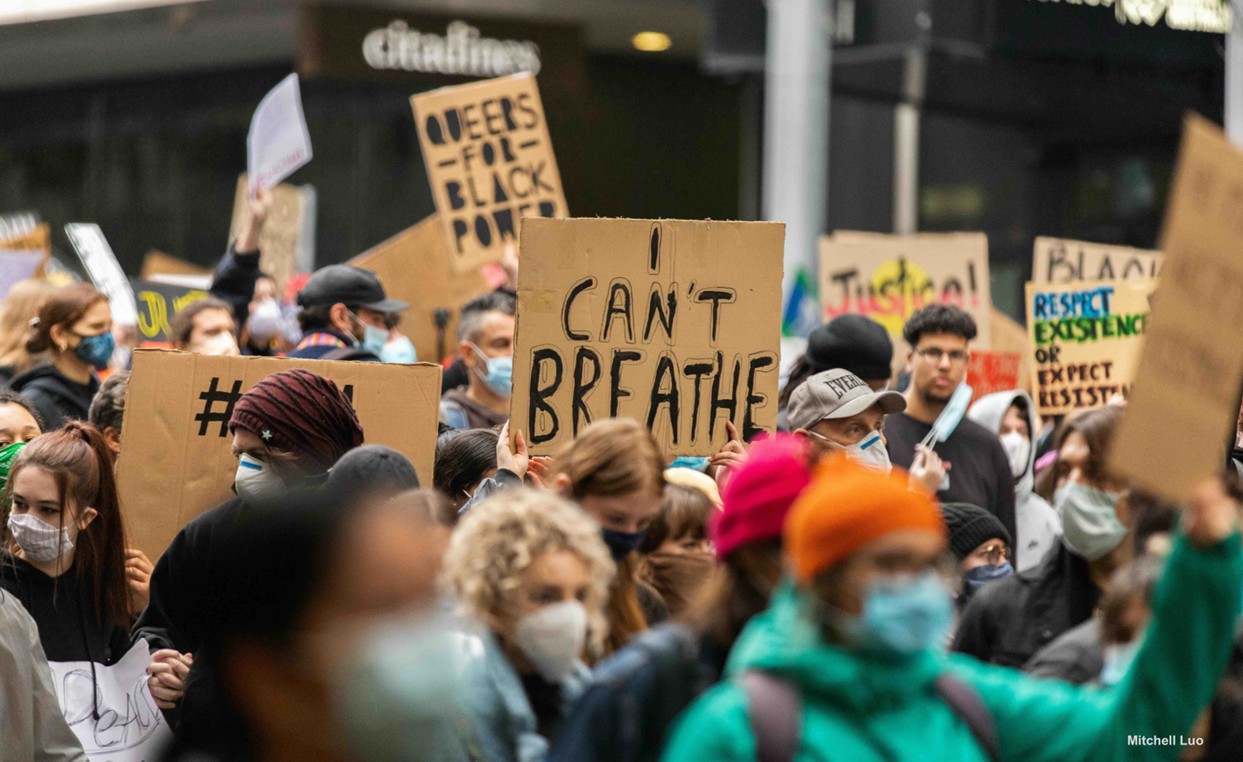
This past week has been devastating. The news has been relentless about federal immigration enforcement expanding into cities and neighborhoods. Meanwhile, the family of a mother killed during an ICE operation in Minnesota is grieving. Her community is grieving.
Immediately after she was gunned down after dropping off her child at school, competing stories began circulating. Stories that included carefully worded statements, partial explanations, official justifications, and conflicting official accounts about what happened and why. Afterwards, there were resignations from within government agencies; protests, lawsuits, and grief that has nowhere easy to land.
So what is the truth? Some of us watched the footage. Some of us read the reports. All of us felt the same sinking recognition: that the truth is being managed.
At the same time, we live in a country where reality itself feels unstable. A country where the violence of January 6 is still minimized or denied. A nation where a free and fair election is called fraudulent without evidence, despite courts and officials saying otherwise. And an administration lying about affordability that does not match the lived experience of most families.
These lies are not harmless distortions. These are not abstract debates. Neither are they simply differences of opinion. These lies shape policy. They shape enforcement. They shape whose lives are protected—and whose are treated as expendable. And for many of us, the weight of it is not just political. It is emotional. It is spiritual. It is exhausting.
People are afraid—afraid to speak, afraid to protest, afraid to be noticed. Communities are told they are threats. Dissent is reframed as disloyalty. Questioning is labeled as extremism, and the term “domestic terrorists” is applied to anyone daring to disagree and readily used as justification for cruelty.
Because when truth is unclear, or selectively told, or wrapped in half-statements and slogans, the cost is never evenly distributed. When power insists on its own version of events—when truth is filtered, delayed, or denied—the consequences do not fall on those who craft the narrative. They do not fall on the powerful first. They fall on the vulnerable. They fall on the unseen. They fall on the innocent. The consequences fall on communities. On families. On people who did not choose the spotlight but find themselves caught in the consequences.
So let’s name this plainly, without commentary or defense: Lies exploit the innocent. This has proven true this week. It has been true in our history. And it is not new.
What makes this moment especially difficult is that lies often feel safer than the truth. They are simpler. More satisfying. Less demanding. Lies allow us to tidy up reality just enough to avoid discovery—just enough to avoid responsibility. What makes lies so dangerous is not just that they deceive—it’s that they reassure. They offer a version of the world where no one has to change, no one has to repent, and no one has to tell the whole story.
Truth, on the other hand, asks us to see what is actually happening. To sit with grief we didn’t cause but now must acknowledge. To recognize harm even when it’s justified with official language. Truth is harder. Truth disrupts. Truth demands that we see what is actually happening, not just what we wish were happening.
This struggle between truth and power, between public claims and private cruelty, did not begin in our lifetime. Truth is often resisted—by individuals and by empires alike.
And many of us sense—whether we can articulate it or not—that we are being asked, again, to choose what kind of people we will be in a moment like this. Perhaps not yet settled on what we believe.
But whether we are willing to see the truth.
That tension between what is said and what is real, between official claims and lived consequences, is not unique to our time. It sits at the very center of the Christmas story we often prefer to skip past.
Matthew tells us that when visitors from the East arrive in Jerusalem, asking about a newborn king, King Herod is terrified. Not curious. Not cautious. Herod is terrified.
So he lies.
He tells the visitors that he wants to worship this child. He asks them to search carefully. He asks them to report back. It sounds reasonable. It sounds faithful. It sounds like transparency. But it is a performance.
Because Herod is not seeking truth—he is seeking control. And when the visitors do not return, when the truth escapes him, Herod reveals the lie, when he orders the slaughter of the children of Bethlehem.
This is not a metaphor. This is not symbolic violence. This is state-sanctioned cruelty justified by fear and preserved by deception.
And here’s the part we often want to skip past: Herod does not invent a new strategy. He simply lets the lie finish its work. The lie says: I must protect my power. The lie says that violence is necessary. The lie says that some lives are expendable for the sake of order.
And the innocent pay the price.
Nadia Bolz-Weber, in her book, Accidental Saints, reminds us that this brutality is not an accidental footnote to the Christmas story. It is part of the story. God does not enter a sanitized world. God enters a world where rulers lie, where power is fragile, and where children die because adults are afraid of losing control.
Jesus is born into a reality shaped by deceit and enforced by violence. Which means that the world we are living in—a world marked by contested truth, institutional cruelty, and managed narratives—is not foreign to God. It is precisely the world into which Christ comes.
And that is why Jesus reminds us, not as a slogan, not as a platitude, but as a warning and an invitation: Truth is not neutral. Truth is not safe. Truth is a choice. And—Truth frees those who choose it.
Our companion book, Accidental Saints, invites us away from the idea that truth is something we wield—an argument to win, a position to defend, or a weapon to expose others. Instead, Pastor Nadia frames truth as something that first reveals the truth about us.
Her stories circle around moments when people stop managing their image—when the masks crack, and the curated versions of faith fall apart. Truth shows up not as moral clarity from a distance, but as confession up close: addiction named out loud, resentment acknowledged, doubt admitted, harm remembered rather than erased. In these moments, truth is not clean or comfortable—but it is real.
What becomes clear is that, in Christian communities, truth is not primarily about being right. It’s about being known. Grace struggles to find us when we insist on being impressive, and forgiveness struggles to find us if we refuse to be honest. The church, at its best, is not a gathering of people who have figured things out, but a place where people risk telling the truth about their lives—and discover that God is already there.
This kind of truth feels costly because it dismantles self-deception. It strips away the false stories we tell about ourselves and others. But it is also freeing. Truth, in these stories, does not lead to shame; it leads to connection. It becomes the doorway through which healing, reconciliation, and actual transformation can begin.
Truth is not an abstract doctrine. It is embodied, spoken, confessed, and received in community. And that, ultimately, is where it aligns so closely with the gospel: the truth that sets us free is not the truth we use to judge others, but the truth we dare to tell in the presence of mercy.
The Rev. Dr. Martin Luther King, Jr. understood something essential about truth that our moment is relearning the hard way: lies do not merely deceive—they organize cruelty. Like now, King lived in a world where official statements contradicted lived reality. Where authorities spoke of “law and order” while children were beaten. Where violence was justified as necessary, and dissent was labeled dangerous. He knew that lies don’t just confuse people—they make injustice sustainable.
That’s why King insisted that truth must be spoken aloud, even when it is inconvenient, even when it disrupts public comfort.
In his Letter from Birmingham Jail, King names one of the most dangerous lies of all: the lie of timing. The lie that says, “Now is not the right moment.” The lie that asks the suffering to wait until those in power decide it is time for change.
King rejected that lie outright because he saw what waiting does to the vulnerable. Delay preserves injustice. Silence protects cruelty. And moderation, when it refuses truth, becomes a collaborator. King also understood something Herod understood—but used for opposite ends: that truth threatens power. Herod responded to that threat with violence. King responded with courage. And he paid for it.
Like the prophets before him, and like Jesus Himself, King tells us—by word and by witness—that truth is never neutral. It either confronts injustice or it serves it. There is no safe middle ground.
This is why King’s work still unsettles us. Because he does not allow truth to remain theoretical. He insists that truth has consequences. That truth demands a response. That truth costs something. And yet King never believed truth existed for destruction alone. He believed truth was redemptive. That it could bend the arc of history—not magically, not quickly, but faithfully.
If you obey my teaching, you are really my disciples; 32 you will know the truth, and the truth will set you free.
John 8 31-32
Which brings us back to the choice before us. Lies exploit the innocent. Truth frees those who choose it. King chose truth, knowing it would cost him comfort, safety, and eventually his life. Not because truth guaranteed victory—but because truth was the only path that honored human dignity. And that same choice faces us now.
So where does this leave us? Not with easy answers, not with certainty, and not with the comfort of believing that truth belongs only to one side or one moment in history. It leaves us with a choice.
Jesus does not say that truth will make everything simple. He does not say it will make us popular. He does not even say it will make us safe. He says that truth will make us free. And freedom, in Scripture, is never passive. Freedom is something we step into. Something we practice. Something we choose—again and again.
Lies exploit the innocent. Truth frees those who choose it. Choosing truth does not mean we must have perfect clarity. It means we refuse to participate in denial. It means we resist stories that erase suffering or justify cruelty. It means we tell the truth about what we see, what we feel, and what we fear—even when that truth unsettles us.
But it also means we tell the truth about ourselves. Nadia Bolz-Weber reminds us that grace can only reach what we are willing to name. Confession is not about shame—it’s about honesty. And honesty is where transformation begins.
Martin Luther King Jr. understood this too: that truth spoken in love is not an act of aggression, but an act of faith. That refusing silence is sometimes the most faithful thing we can do.
So here are a few simple, faithful next steps—not as a checklist, but as practices: First, practice truth-telling. Pay attention to the stories you repeat—about the world, about others, about yourself. Ask whether they clarify reality or conceal it. Choose honesty over convenience or political affiliation.
Second, practice listening. Especially to voices shaped by grief, fear, or marginalization. Truth often arrives through people whose experiences make us uncomfortable. Stay present long enough to hear them.
Third, practice courage. Truth does not always require confrontation, but it does require refusal—refusal to laugh at cruelty, to spread distortion, to look away from harm.
And finally, practice hope. Not the kind of hope that denies reality, but the kind that trusts God to be at work within it. The kind of hope that believes truth, once chosen, can still open a way forward.
Because the world Jesus enters—then and now—is a world where lies do real damage. And yet, it is still the world God loves. Christ does not arrive after the truth is sorted out. He arrives while it is still contested.
Still painful. Still unfolding, Jesus leaves us with this freedom: to choose truth, to walk in it together, and to trust that God will meet us there.
You can join us each Sunday in person or online by clicking the button on our website’s homepage. Click here to watch. This button takes you to our YouTube channel. You can find more information about us on our website at FlintAsburyChurch.org.
This is a reminder that we publish a weekly newsletter called the Circuit Rider. You can request this publication by email by sending a request to FlintAsburyUMC@gmail.com, or let us know when you send a message through our website. We post an archive of past editions on our website under Connect – choose Newsletters.
Pastor Tommy
Nadia Bolz-Weber. Accidental Saints: Finding God in All the Wrong People. NY: Convergent Books, 2015. (ISBN 978-1-60142-755-7 ).