We come to our final episode of this series as our nation celebrates the Declaration of Independence, adopted 250 years ago. For the most part, our experiment in representative democracy is working, despite some daunting challenges along the way.
However, it feels as though something precious, something protected by the Declaration, although it isn’t specifically named, is slipping away.
Most Americans still believe in hard work. They still believe that people deserve an opportunity to build a good life, raise a family, contribute to their community, and retire with dignity. They may disagree passionately about how to accomplish those goals, but beneath those disagreements is a shared longing for something we have always called the “American Dream.”
That dream has never been about guaranteeing equal outcomes. It has been about preserving the possibility that ordinary people, through opportunity, responsibility, and perseverance, might flourish. It depends upon something larger than individual success. It depends upon the belief that we’re in this together.
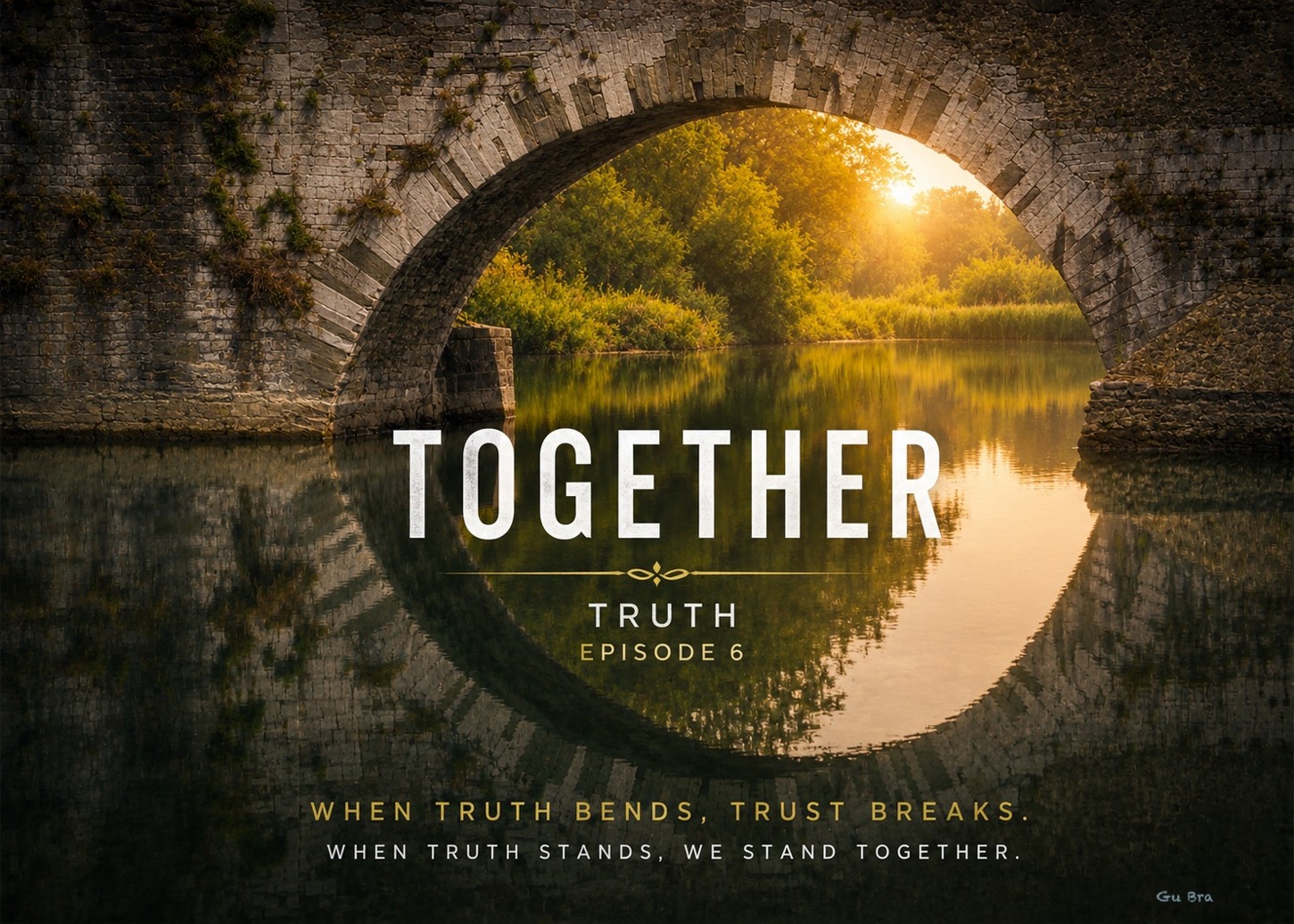
Think about a bridge. Most of us cross bridges without giving them a second thought. They quietly carry thousands of people every day—young and old, rich and poor, Republican and Democrat, lifelong citizens and first-time visitors. A bridge doesn’t ask who deserves to cross. It simply does what it was built to do. Of course, bridges aren’t free. They exist because generations before us believed that some things are worth building and maintaining together.
Our companion book ends by reflecting on that very idea. Walter Isaacson observes that the economic assumptions guiding our nation over the past several decades have created extraordinary prosperity for some while leaving many others wondering whether the American Dream is still within reach. Whether one agrees with every aspect of his analysis is less important than the question it raises:
Who should our economy serve?
That is a question worthy of honest debate. Yet increasingly, honest debate seems to be giving way to something else.
Rather than carefully weighing ideas, we are encouraged to dismiss them with labels. Instead of asking whether a proposal is wise, truthful, or serves the common good, we are told what to call it. Labels become substitutes for thinking. They are often chosen, not to invite conversation, but to end it before it begins.
Truth suffers whenever language is used that way.
That should concern every Christian. The Ninth Commandment does not merely prohibit lying in a courtroom. It calls God’s people to bear truthful witness about our neighbors. Surely that includes refusing to misrepresent one another’s motives, beliefs, and ideas for the sake of winning an argument or holding onto power.
The result is that most of us feel unheard. We work hard. We contribute to our communities. We care for aging parents, teach children, repair roads, grow food, start businesses, serve in hospitals, factories, and churches. Yet most of us wonder whether the leaders and institutions meant to serve “the people” still remember the people they were created to serve.
We rarely notice a bridge as it faithfully carries us across the river. We only notice it when it begins to fail. Perhaps the same is true of the common good. We rarely think about it until we begin to lose confidence that it will still carry us.
Perhaps that is why so many today are searching for leaders who speak about the common good rather than simply appealing to our fears or our grievances. Perhaps people are hungry for a public life where truth matters more than slogans, where ideas are judged honestly, and where our deepest disagreements are met with integrity rather than distortion.
What if our hunger is telling us something?
What if the deepest crisis we face is not simply political or economic?
What if we have forgotten what it means to belong to one another?
The American experiment did not begin God’s story. It became another chapter in humanity’s long struggle to learn to live together for the common good, continuing a story that began at creation’s very beginning and was shared with us in scripture.
Not because America was set apart by God above every other nation. And not because our founders agreed on what Scripture says. But because every generation must wrestle with the same questions: How do people live together? How is power used? Who belongs? What does justice require?
Thousands of years ago, God’s prophets spoke to people about God’s vision for a different kind of community. A community where justice was stronger than power and peace was stronger than fear. Through the prophet Isaiah, God declared: “The effect of righteousness will be peace. The result of righteousness will be lasting security forever.” (Isaiah 32:17)
Peace, in the Bible, is never simply the absence of conflict. It is the presence of right relationships—with God, with one another, and with creation. The Hebrew word shalom describes a community where people flourish together because justice and truth are allowed to take root.
Jesus brings that same vision to the present. When asked to summarize God’s law, He did not speak first about individual success or personal achievement. He answered: “Love the Lord your God with all your heart, with all your soul, and with all your mind. This is the greatest and most important commandment.” But then Jesus added, “The second most important commandment is like it: Love your neighbor as you love yourself” (Matthew 22:37–39).
It’s critically important that we not forget that love of God and love of neighbor cannot be separated. The health of our relationship with God is revealed by the way we treat one another.
Paul also writes about God’s vision in a letter to the church in Ephesus. Paul was writing to a church divided by history, ethnicity, religion, and culture, when he announces something extraordinary: “For Christ himself has brought us peace by making Jews and Gentiles one people. With his own body he broke down the wall that separated them and kept them enemies” (Ephesians 2:14).
Notice what Paul does not say. He does not say that one side defeated the other. He does not say that one group finally gained enough power to impose its will. He does not say that peace comes when everyone thinks alike.
Paul says that Christ tore down the wall. And whenever a wall comes down, the possibility of building a bridge appears.
You see, a wall divides. It separates. A wall teaches us to fear those on the other side. But Christ came, Paul reminds us, to remove walls, not reinforce them.
Paul’s letter continues: “So then, you Gentiles are not foreigners or strangers any longer. You are now fellow citizens with God’s people and members of the family of God” (Ephesians 2:19).
For centuries, Israel understood itself as God’s covenant people. Their story was the story of God’s faithfulness—from slavery in Egypt, through the wilderness, into the Promised Land. But now Paul announces something almost unimaginable. Through Christ, Gentiles are no longer outsiders looking in. They, too, have become fellow citizens and members of God’s family.
Paul reminds us that Gentiles, including us, are fellow citizens and members of God’s family. We are people who belong together.
That is the gospel, church.
According to scripture, God’s purpose isn’t merely to save isolated individuals. Although this is clearly an important part. More importantly, God’s purpose has always been to create a people—a community shaped by truth, justice, mercy, and love. This is why we can view the American experiment as another chapter in humanity’s ongoing struggle to learn how to live together.
And since Christ has declared us to become one people, then every question we ask about our common life begins here: How do we live together as people who already belong to one another?
What if we believe that Christ has really torn down the walls that divide us? What if we stopped treating those who disagree with us as enemies to defeat and began seeing them as neighbors to understand?
Imagine what that might look like.
Imagine becoming known as people who build bridges instead of walls. Not because bridges are easy to build. They aren’t. They require patience, sacrifice, trust, and a willingness to meet someone halfway. But every bridge says something walls never can: there is another way.
It is through Christ that all of us are able to come in the one Spirit into the presence of God.
Ephesians 2:14–22
Imagine a country where truth mattered more than slogans. A nation where we judge ideas by their wisdom rather than by the labels attached to them. Where disagreement is not viewed as betrayal, but as an opportunity to learn.
Imagine an economy measured not only by the wealth it creates, but by the opportunities it provides. A society where success is celebrated, not because a fortunate few have prospered, but because ordinary families can work hard, care for one another, and still believe the future will be better for their children.
Imagine leaders who understand that public office is a public trust, not a pathway to personal glory.
Imagine citizens who refuse to reward lies, no matter who tells them, and who insist that truth is never negotiable because democracy itself depends upon it.
Imagine Christians becoming known, not for winning arguments, but for refusing to bear false witness. People who speak truth with humility, who listen before judging, who seek justice without hatred, and who remember that every person they meet bears the image of God.
This vision is not naïve. It is the vision of Isaiah. It is the vision of Jesus. It is the vision Paul describes when he tells us that Christ has made us one people.
Perhaps the greatest gift we could give our nation in its 250th year is not louder voices or stronger opinions. Perhaps it is a community willing to live as though we truly believe…We’re in this together.
Over the past six weeks, we have explored some of the most important words in our faith and in our democracy. Us. Evident. Equal. Dignity. Pursuit. And today…Together.
Each week has reminded us that truth is more than getting our facts right. Truth shapes how we see one another. Truth decides whether power serves itself or serves the common good. Truth determines whether we build walls or bridges.
Walls protect us from people we fear. Bridges connect us to people we have yet to understand. Christ chose the bridge.
The day marking the 250th anniversary of our Declaration of Independence is over. Soon, the fireworks will be over. The flags will be folded away. And the celebrations will begin to fade.
But the experiment continues.
Every generation must decide whether those words—all are created equal—will remain merely something we celebrate or become something we practice.
The church has a unique calling in that decision.
Long before there was an American experiment, God was already forming a people whose lives would bear witness to a different way of living together. A people shaped by truth instead of fear. By justice instead of favoritism. By mercy instead of vengeance. By love instead of power.
That calling now belongs to us.
Not because America is God’s chosen nation. But because we are God’s people. And wherever God’s people are found, they are called to tell the truth, seek justice, love their neighbors, and work for the common good.
The Declaration gave our nation an extraordinary vision. Christ gives the Church its enduring mission. May we have the wisdom to hold both with gratitude.
And may future generations be able to say that, when truth was tested, we chose to stand together.
You can join us each Sunday in person or online by clicking the button on our website’s homepage. Click here to watch. This button takes you to our YouTube channel. You can find more information about us on our website at FlintAsburyChurch.org.
This article is part of a weekly newsletter called the Circuit Rider. You can request this publication by email by sending a request to FlintAsburyUMC@gmail.com, or let us know when you send a message through our website. We post an archive of past editions on our website under Connect – choose Newsletters.
Pastor Tommy
The series concept and some content come from Walter Isaacson. The Greatest Sentence Ever Written. NY: Simon & Schuster, 2025.