
We are watching a war unfold that will not end when the headlines fade.
The conflict with Iran is already reshaping lives in ways that will take decades to repair. Families are being displaced. Economies are destabilizing. Entire regions are being pushed further into cycles of violence that will echo for generations. Even if the fighting stopped tomorrow, the relational damage—the mistrust, the grief, the anger—would remain.
And yet, alongside the destruction, there is something else happening that is harder to name but just as important.
There is a tone. A kind of certainty.
A way of speaking about the conflict that divides the world cleanly into sides—right and wrong, good and evil, us and them. And if we are honest, there is something in us that is drawn to that kind of clarity. It simplifies things. It tells us where we stand. It reassures us that we are on the right side of history.
But history also teaches us something else: When certainty becomes absolute, compassion often becomes optional. And when compassion becomes optional, cruelty becomes easier to justify. Not because people suddenly become evil—but because they become convinced they are right.
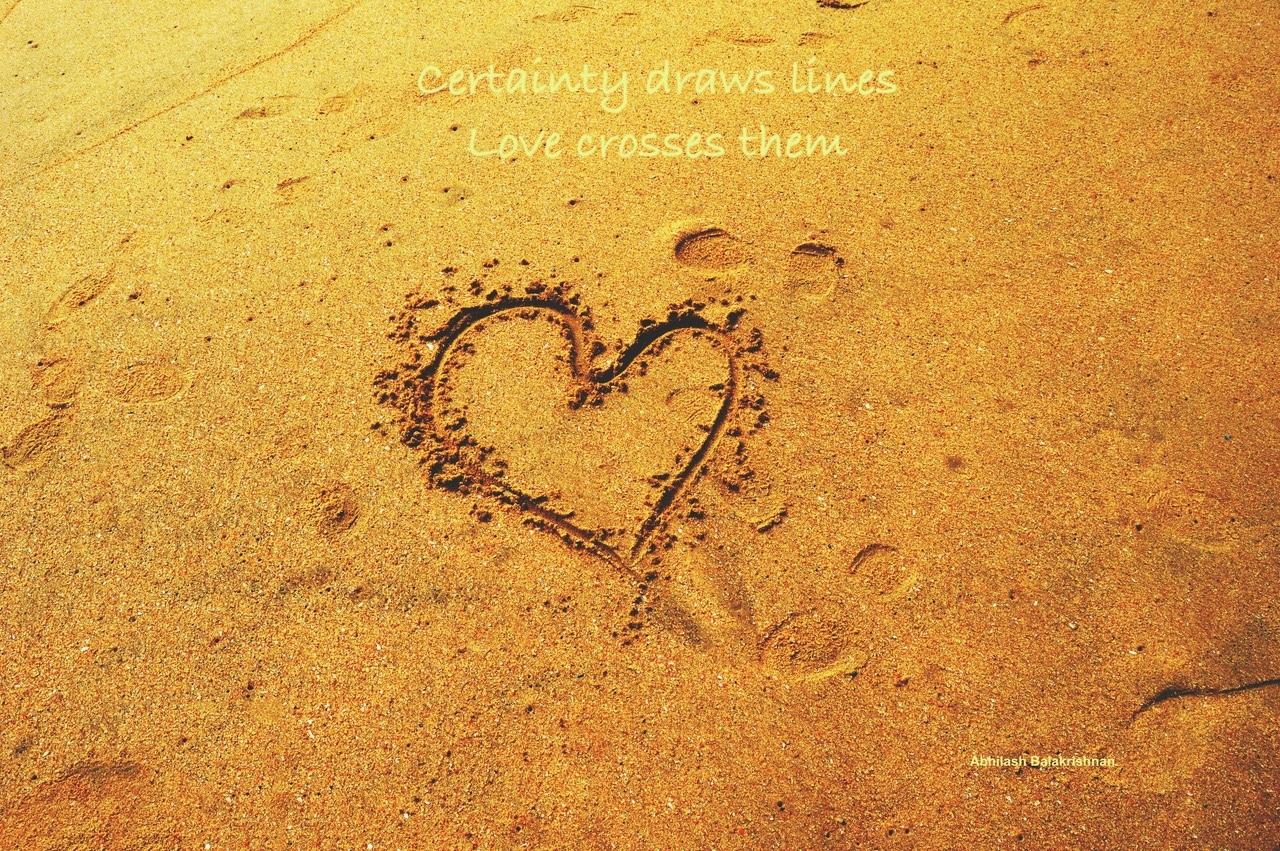
This is the danger we rarely name: certainty draws lines, but love crosses them. And when certainty hardens, those lines become easier to defend than the people on the other side.
Faith is powerful. It can inspire sacrifice, generosity, courage, and hope. It can call people to care for others and to work toward peace in a fractured world.
But faith also carries a kind of heat. And like fire, that heat can either give life or take it.
Fire in a fireplace warms a home. It creates space for people to gather, to rest, to be sustained. But the same fire, once it slips beyond its boundaries, does not become a different fire. It becomes destructive.
The danger is not the fire. The danger is how easily we believe we are the ones who can control it. When the fire spreads, it doesn’t just change what we do—it changes how we see. We begin to sort the world into categories that feel necessary, even righteous.
But over time, those categories become barriers. Because certainty draws lines. Love crosses them.
In recent years, a particular expression of faith—often called Christian nationalism—has gained influence in public life. At its core, it blends religious identity with national identity. It assumes that our nation holds a special, even sacred role, and that preserving it—defending it, advancing it—is aligned with the will of God.
That kind of belief can feel compelling, even comforting. It offers clarity. It offers purpose. It offers a sense of being part of something larger.
But it also carries a risk.
Because when faith becomes fused with power, and power is fueled by certainty, the fire begins to move. We stop asking, “What is good?”
And we start asking, “What is justified?”
We begin to see opponents not simply as people we disagree with, but as obstacles. We become more willing to accept harm—so long as it serves a larger goal. And when that goal is wrapped in the language of faith, it becomes even harder to question.
This is not new. It is a deeply human pattern.
In our companion book for this series, The Little Prince, the young boy encounters and observes adults. And one thing they all have in common is that each one is certain.
The king is certain about authority. The businessman is certain about ownership. The lamplighter is certain about duty. And the geographer is certain about knowledge. Each of them lives inside a system that makes perfect sense—to them.
And yet, from the outside, something is off. They are so certain that they no longer question what they are doing. They are so committed to their perspective that they cannot see beyond it.
They are not villains. They are not malicious. They are simply… convinced.
And in their certainty, they lose something essential. They lose the ability to see clearly. They lose the ability to love freely. They lose the ability to recognize what actually matters.
The young boy exclaims, “Grown-ups never understand anything by themselves, and it is tiresome for children to be always and forever explaining things to them.”
But his observation isn’t really about age. It is about what happens when certainty replaces curiosity… when systems replace relationships… when being right becomes more important than seeing clearly.
This week, we celebrate Palm Sunday, which tells a similar story. A crowd gathers. They celebrate. They welcome Jesus as He enters Jerusalem, certain that He is a King. They are certain about who He is. Certain about what He has come to do. Certain about how things are supposed to unfold.
But their certainty blinds them. They expect power to look a certain way. Strength to look a certain way. Victory to look a certain way. And when it doesn’t… they struggle to recognize what is right in front of them.
And that certainty created a picture of who Jesus had to be. But when reality didn’t match the picture, they couldn’t see him clearly anymore.
Because certainty draws lines. Love crosses them. And they were holding too tightly to the lines. The tragedy is not that they rejected Jesus. It is that they misunderstood Him.
Perhaps they weren’t there when Jesus spoke to the crowd that first heard the Sermon on the Mount. Perhaps, if they were there, they would have heard Jesus say, “You have heard that it was said, ‘Love your neighbor and hate your enemy.’ But I tell you, love your enemies and pray for those who persecute you.”
But here is what I tell you. Love your enemies. Pray for those who hurt you.
Matthew 5:43–48
This is not abstract. It is not sentimental. It is specific—and it is disruptive.
Love, as Jesus describes it, refuses to draw the same lines we draw. Love extends beyond reciprocity. Jesus also said, “If you love those who love you, what is that?” Instead, Jesus tells us that love moves toward those we would rather avoid and seeks the good even of those we do not understand.
This is where his teaching becomes unmistakably clear. The kind of love he describes does not stay inside the lines we draw. It moves beyond them—intentionally, consistently.
Because certainty draws lines. Love crosses them. This kind of love does not erase differences. Nor does it pretend harm is acceptable.
Instead, love refuses to let hatred define the relationship. It refuses to let certainty become an excuse for cruelty.
And in the final line, Jesus raises the bar even higher: “Be perfect, therefore, as your heavenly Father is perfect.” Not perfect in performance. Rather, allow yourself to be perfected in a love that begins with humility. A love that does not change depending on who is in front of us.
Near the end of The Little Prince, we find a clear contrast to certainty: “It is only with the heart that one can see rightly; what is essential is invisible to the eye.”
Certainty depends on what is visible: who is winning, who is losing, who is right, and who is wrong. But love—real love—sees differently. It sees the person behind the position. The story behind the conflict. The humanity behind the label.
And once you begin to see that way, it becomes much harder to justify harm… even when harm feels deserved.
As we close this series, the question is not whether we understand these ideas. The question is whether we are willing to live them. Because the world we are living in will continue to reward certainty. It will continue to divide. It will continue to push us toward quick judgments and clear sides.
But the invitation of this series—of the Sermon on the Mount, and even of The Little Prince—is different. It is an invitation to slow down. To see more clearly.
To resist the pull of easy certainty. To choose love that is not limited by tribe, agreement, or outcome.
To become people who: Notice when our certainty is burning hotter than our compassion. Allow our beliefs to challenge us, not just confirm us. Refuse to reduce others to categories. Practice love in small, concrete ways—especially when it is difficult
Because in the end, the question is not whether we stood on the right side. It is whether we become the kind of people who could love on any side. And that kind of love—quiet, costly, and often unnoticed—may be the most powerful thing in the world.
The world will continue to reward certainty. But the invitation before us is different. Not to be more certain… but to be more loving.
Because in the end, certainty draws lines. Love crosses them.
You can join us each Sunday in person or online by clicking the button on our website’s homepage. Click here to watch. This button takes you to our YouTube channel. You can find more information about us on our website at FlintAsburyChurch.org.
This is a reminder that we publish a weekly newsletter called the Circuit Rider. You can request this publication by email by sending a request to FlintAsburyUMC@gmail.com, or let us know when you send a message through our website. We post an archive of past editions on our website under Connect – choose Newsletters.
Pastor Tommy
Series concept and substantial content created and shared by © The Rev. Jeremy Peters, Court Street United Methodist Church, 2026. Used with permission.
Additional content from: Antoine de Saint-Exupéry. The Little Prince. Translated by Richard Howard. NY: Harper Collins, 2000.7