
Like thousands of other boys before me, I was a Boy Scout.
I loved it. I loved camping and building things. I loved learning how to make do with what I had. My favorite merit badge was Pioneering. Give me some rope, a few poles, and a challenge to solve, and I was happy. For me, it wasn’t enough to survive in the wilderness. I wanted to thrive.
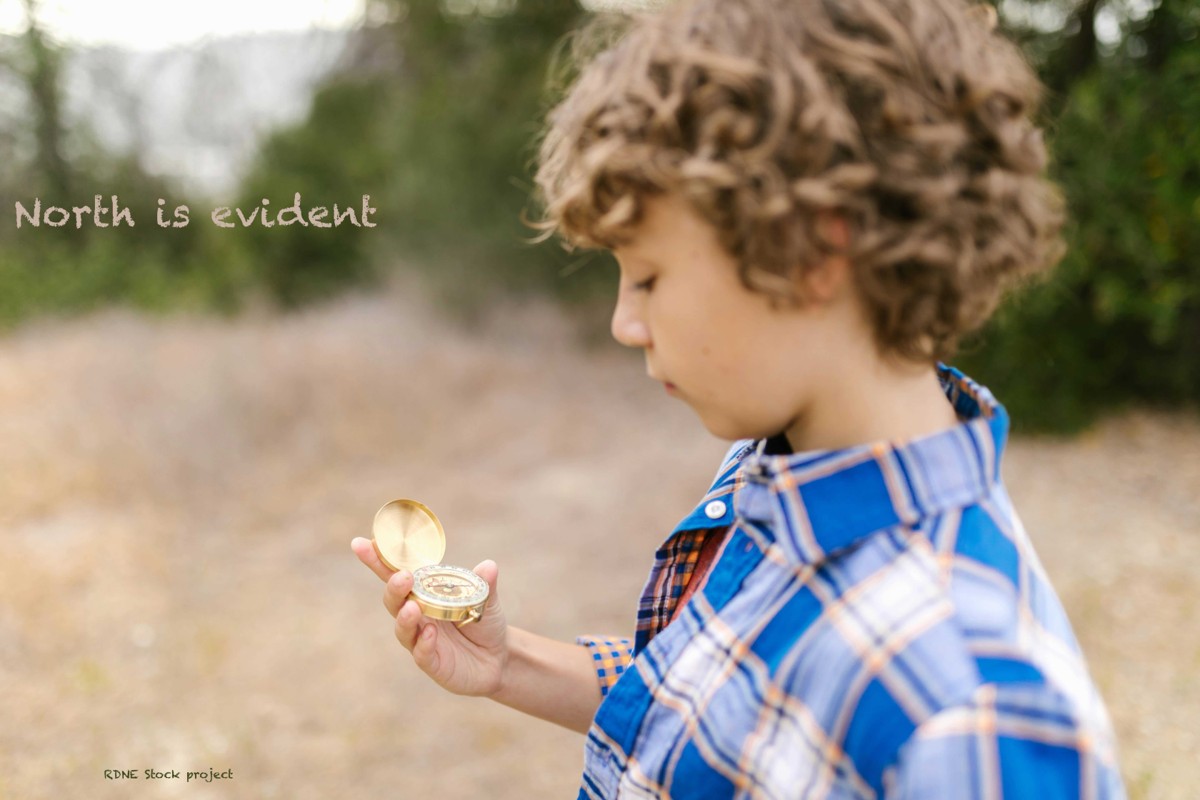
One of the skills every scout learns is how to use a compass. Back then, there was no GPS in your pocket. If you got turned around in the woods, you needed to know how to find your direction.
What fascinated me was how simple a compass seemed. No batteries. No screen. No moving parts except a tiny needle. Yet that little needle could help you find your way through miles of unfamiliar terrain.
The secret, of course, is that the compass isn’t creating north. The compass is responding to north. North already exists. For a compass, north is self-evident. The compass simply points toward it.
When you’re hiking through dense woods, however, it is not unusual to question the compass. The sun may be hidden by the trees. Clouds may cover the sky. Darkness may be setting in. Every instinct may tell you that you should be heading one direction while the compass insists on another.
In moments like that, the temptation is not to doubt yourself. The temptation is to doubt the compass. But the compass has no reason to lie.
It doesn’t care where you want to go. It doesn’t care what you hope is true. It doesn’t care what is convenient. It simply points north.
These experiences helped me to learn something that has stayed with me all these years: direction matters. You can have plenty of energy. You can work hard. You can walk fast. But if you’re headed in the wrong direction, none of those things will get you where you want to go.
You first need to know which way is north.
And that lesson feels especially important today.
Many of us have reached a point where we no longer know what to believe. Every day, we’re bombarded with competing claims, competing narratives, competing explanations, and competing versions of reality.
The problem isn’t simply that people lie. The truth is that human beings have always lied.
A child breaks a lamp and immediately begins crafting an explanation. A teenager presents only the facts that support their case. An adult tells a story in a way that makes them look a little better, and someone else looks a little worse.
We all know what it is like to shape a narrative. Most of the time, the consequences are small. Sometimes they are devastating. Either way, we have wandered from the truth. In compass language, we have ignored north.
But there is a second level of deception that is more dangerous.
A fact can be technically accurate and still be presented in a way that leads people toward a false conclusion. Important details can be omitted. Quotes can be removed from their context. Arguments can be framed so that listeners arrive exactly where the speaker wanted them to go.
Children do it. Advertisers do it. Political campaigns fill the airwaves with it. News organizations do it. And yes, sometimes even preachers do it.
This is why fact-checking matters. It is not merely an exercise in proving someone wrong. Fact-checking is a way of asking whether the compass is still pointing north.
Yet there is a third level of deception that is even more dangerous. The greatest threat is not a lie. The greatest threat is forgetting which way is north.
A child may ignore the compass. A politician may try to bend the needle. But the greatest danger comes when a culture loses its shared understanding of what north even means.
In his recent book All We Say, Ben Rhodes argues that much of American history can be understood as a continuing argument about who “we” are as a people. The speeches he highlights reveal that our deepest conflicts are not simply about policy. They are about identity. They are about belonging. They are about what story defines us as a nation.
As we approach the 250th anniversary of the Declaration of Independence, those questions matter more than ever.
For nearly two and a half centuries, the Declaration’s claim that all people are created equal has functioned as a kind of American true north. Not because we have lived up to it. Clearly, we have not. But generation after generation has appealed to those words as a standard against which the nation should be measured.
The abolitionist appealed to it. The suffragist appealed to it. Civil rights leader appealed to it. The reformer appealed to it.
The question was never whether America had arrived. The question was whether America was still moving toward its own ideals, and how to keep us going in the right direction.
The first lie points us in the wrong direction. The hundredth lie makes us forget there ever was a north. And we’ve been told thousands of lies. When truth bends, trust breaks. Let’s face it. Trust broke a long time ago for the vast majority of us.
So that raises a question that is just as urgent today as it was two thousand years ago: How do we recognize the truth when we have lost our bearings?
The good news is that God doesn’t abandon people who have lost their way. Throughout the Bible, God repeatedly sent prophets to people who had forgotten which way is north.
Again and again, leaders become convinced that power matters more than justice. Nations become convinced that prosperity matters more than righteousness. Religious people become convinced that ritual matters more than compassion.
And each time, God sends someone to remind them of what they already know but have chosen to forget.
Isaiah calls the people back to justice. Amos calls the people back to righteousness. Micah calls the people back to humility. Jeremiah calls the people back to faithfulness.
Prophets are not fortune-tellers predicting the future. Profits are truth-tellers, reminding people of the truth they already know.
In a sense, prophets are human compasses.
When kings, priests, presidents, and nations lose their bearings, the prophets point north. Not because the truth has changed. Because the people have.
This is why the words of Isaiah remain so powerful: “Whether you turn to the right or to the left, your ears will hear a voice behind you saying, ‘This is the way. Walk in it’” (Isaiah 30:21).
God has always been, and continues to be, in the business of helping lost people find their way home. Yet there is a difference between pointing toward the truth and standing in the presence of Truth itself.
That difference brings us to Jesus.
In the final hours before Jesus’ crucifixion, He was arrested and abandoned by many of His followers. He was brought before Pontius Pilate, the Roman governor with the authority to decide whether Jesus would live or die. From a human perspective, Pilate held all the authority.
After all, he commanded soldiers. He represented the empire. He controlled the courtroom. And, he issues orders that change lives.
Jesus stood before Pilate as a prisoner. At least that is how it appears.
But John’s Gospel invites us to see something deeper. John helps us see that while Pilate possesses power, Jesus possesses truth. And those are not always the same thing, despite claims to the contrary.
When Jesus says to Pilate, “The reason I was born and came into the world is to testify to the truth. Everyone who belongs to the truth listens to my voice,” Pilate responds with one of the most famous questions in all of Scripture: “What is truth?”
It is a remarkable question. People never stop asking it. What is truth? Whose truth? Can truth even be known? Does truth belong to those with the loudest voices, the greatest influence, or the most power?
Pilate’s question sounds surprisingly modern. Yet John’s Gospel reveals a tragic irony. Pilate asks the question while looking directly at the answer.
Truth is standing right in front of him. The compass is working perfectly. The problem is not the compass. The problem is that Pilate doesn’t trust where it points.
Like so many leaders before him, Pilate became oriented toward power rather than truth. His decisions were shaped by political pressure, public opinion, and self-preservation. Pilate can recognize power, but he can’t recognize truth.
And that may be the greatest danger we face.
I was born and came into the world for this one purpose: to speak about the truth. Whoever belongs to the truth listens to me.
John 18:37-38
Most people do not wake up one morning and decide to reject the truth. Instead, we slowly begin trusting other voices more than the compass. We trust our fears. We trust our tribe. We trust our assumptions. We trust leaders who tell us what we want to hear.
Eventually, we find ourselves arguing with North itself.
The story of Jesus and Pilate is not merely about a Roman governor and a Jewish teacher. It is about every moment in history when truth and power stand face to face. And it is about a question each of us must answer for ourselves: When the two point in different directions, which one will we follow?
If Pilate’s question is, “What is truth?”, then perhaps our next question should be, “How do we recognize it?”
As we prepare to celebrate the 250th anniversary of the Declaration of Independence, Walter Isaacson’s The Greatest Sentence Ever Written offers a fascinating clue. Isaacson notes that Thomas Jefferson’s original draft of the Declaration did not say, “We hold these truths to be self-evident.” Instead, Jefferson wrote, “We hold these truths to be sacred and undeniable.”
Benjamin Franklin made a suggestion. He crossed out Jefferson’s words and replaced them with two others: self-evident. At first glance, the change seems minor. It was anything but. Franklin was not rejecting faith. Nor was he claiming that sacred things are unimportant. Rather, he was pointing toward a different way of understanding truth.
A self-evident truth doesn’t become true because a king, dictator, or president declares it. It doesn’t become true because a church teaches it. It doesn’t become true because a political party endorses it. Nor does it become true because a majority votes for it. It is true whether powerful people acknowledge it or not.
Like north. A compass does not create north. A compass recognizes north.
Franklin believed that human equality belonged in that category. “We hold these truths to be self-evident, that all men are created equal…” The remarkable thing about those words is not that America immediately lived up to them. We did not. The remarkable thing is that generation after generation kept returning to them.
When slavery contradicted the promise of equality, abolitionists pointed back to the Declaration. When women were denied the right to vote, suffragists pointed back to the Declaration. When segregation denied equal treatment under the law, civil rights leaders pointed back to the Declaration.
They were not inventing a new compass. They were pointing to the one the nation already possessed. In effect, they were saying, “If this is our north, why are we heading somewhere else?”
That question matters just as much today as it did then.
Every generation faces the temptation to adjust the compass to fit its preferred destination. Every generation is tempted to divide people into categories of greater worth and lesser worth, insiders and outsiders, those who belong and those who do not.
Every generation finds ways to justify inequality while still speaking the language of equality.
The challenge is not merely to say that all people are created equal. The challenge is to live as though it is true.
That is where Jesus becomes so important. Long before the Declaration was written, Jesus lived as though human dignity was already self-evident. He touched those others refused to touch. He welcomed those others refused to welcome. He spoke with people others refused to see.
Again and again, Jesus crossed boundaries that society considered fixed and unquestionable. The poor. The sick. Women. Samaritans. Immigrants. Sinners. Those who respectable society pushed to the margins.
Jesus treated them all as people created and loved by God. He did not simply teach human worth. He demonstrated it. He embodied it.
In Jesus, we discover that truth is not merely something we believe. Truth is something we practice. Truth is something we live. Truth is something we recognize in the face of another human being.
Perhaps that is why self-evident truths matter so much.
They remind us that some things remain true whether they are convenient or inconvenient, popular or unpopular, politically useful or politically costly.
The compass keeps pointing north. The question is whether we have the courage to follow it.
A compass is only useful if we are willing to follow it. Knowing where north is and walking toward it are not the same thing. That is true in the woods. It is true in our nation. And it is true in our spiritual lives.
Pilate stood face-to-face with Truth itself and still chose another path. The tragedy of his story is not that he lacked information. The tragedy is that he lacked the courage to follow where truth was leading.
The same temptation confronts us today.
Every day we are invited to follow voices that appeal to our fears, our prejudices, our anger, or our desire for certainty. Every day we encounter stories designed to reinforce what we already believe and dismiss those who disagree with us.
Yet Jesus calls us to something deeper. He calls us to become people who love the truth more than our assumptions. People who value honesty more than victory. People who care more about being faithful than being right. People who recognize the image of God in others, even when it would be easier to place them into categories of “us” and “them.”
Perhaps that is where we begin. Before sharing a story, ask whether it is true. Before repeating a claim, ask whether it is accurate. Before judging a neighbor, ask whether you have listened long enough to understand them.
Truth grows wherever humility and curiosity take root. And perhaps there is a second step. Spend time with Jesus.
The more time we spend listening to His voice, the easier it becomes to recognize north when other voices compete for our attention.
The prophets pointed toward truth. Jesus embodied truth. And the Holy Spirit continues to guide us toward truth today.
That does not mean we will never get lost. It does mean we do not have to stay lost. A compass does not prevent wrong turns.It helps us find our way again.
This is episode two of our series, Truth, which concludes the day after we celebrate 250 years of following our “true North,” found in our Declaration of Independence. “We hold these truths to be self-evident…”
May we begin our 251st year in pursuit of the truths we believe to be self-evident, that each of us deserves an equal opportunity to life, liberty, and the pursuit of happiness.
In a world filled with competing voices, may we have the wisdom to recognize north. And having recognized it, may we have the courage to follow.
Because when truth bends, trust breaks.
You can join us each Sunday in person or online by clicking the button on our website’s homepage. Click here to watch. This button takes you to our YouTube channel. You can find more information about us on our website at FlintAsburyChurch.org.
This is a reminder that we publish a weekly newsletter called the Circuit Rider. You can request this publication by email by sending a request to FlintAsburyUMC@gmail.com, or let us know when you send a message through our website. We post an archive of past editions on our website under Connect – choose Newsletters.
Pastor Tommy
The series concept and some content come from: Walter Isaacson. The Greatest Sentence Ever Written. NY: Simon & Schuster, 2025.