
Over these past two weeks, many of us have been trying to stay cool during long stretches of dangerous heat. And we’re fortunate. Elsewhere, it seems like every week brings another weather emergency. One community is overwhelmed by floodwaters after receiving months’ worth of rain in a matter of hours. Another watches tornadoes tear through neighborhoods. Out West, drought dries the land until a single spark becomes a wildfire that consumes thousands of acres.
Common sense tells us that we’re seeing more than isolated events. We’re watching a pattern emerge that has gotten progressively worse over the past decade.
What’s left of the National Weather Service and NOAA continue to warn of elevated risks of extreme heat across large portions of the United States this summer, with heat index values exceeding 105 degrees in many places. Meteorologists are also warning that the same weather patterns bringing prolonged heat are contributing to heavy rainfall and flash flooding in some regions, while drought intensifies in others.
Despite what a handful of political leaders may be saying, science is not ambivalent about the cause. In fact, there is an undisputable consensus that our planet is warming because of human activity. There is no longer any doubt that a warmer atmosphere holds more moisture, intensifies heavy rainfall, lengthens heat waves, dries forests and grasslands, and creates conditions that fuel many extreme weather events.
While it doesn’t matter whether climate change created every tornado or every wildfire. It matters a great deal that these disasters are occurring more frequently as a result of warmer, more volatile conditions driven by our choices.
And policy matters. Over the past year, our nation has moved away from many of the policies designed to reduce greenhouse gas emissions and accelerate the transition to cleaner sources of energy. Environmental regulations have been rolled back, renewable energy incentives have been reduced or eliminated, and the expansion of fossil fuel production has once again become a central national priority.
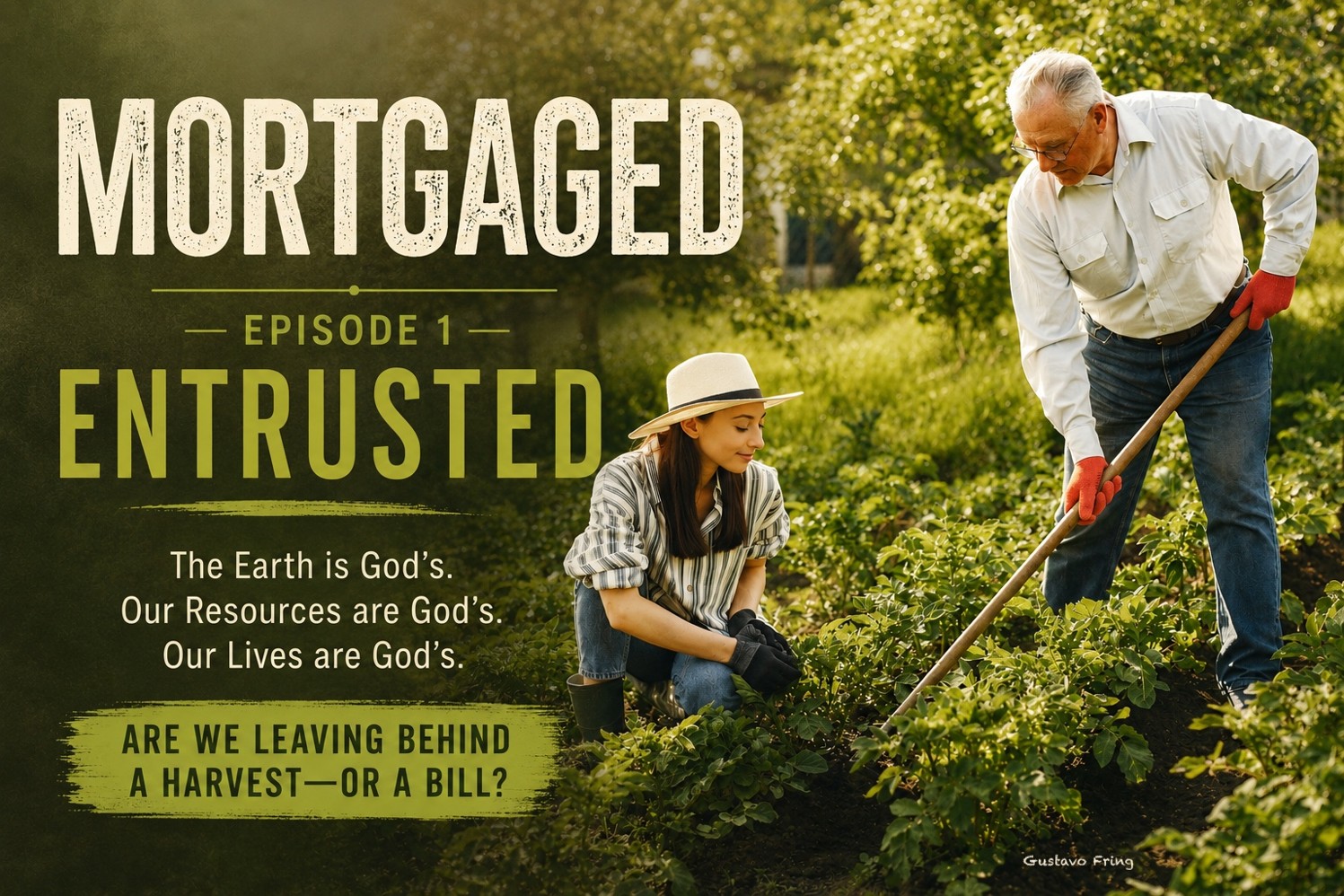
A question that will come up over and over again during this series is this: Are we leaving behind a harvest—or a bill?
When it comes to climate change, we’re racking up charges quickly. Future generations will inherit much of the cost, but the bill has already begun to arrive. Families whose homes are flooded, communities threatened by wildfires, farmers watching crops fail, workers losing wages during dangerous heat, and people struggling to pay rising insurance premiums are already paying for choices that benefited others. The heaviest burden continues to fall on those least able to afford it.
Since key decisions affecting climate change will be debated in Congress and in the courts, every vote matters. But this issue also raises a deeper question for people of faith. What kind of future are we choosing to build? Every public policy reflects what we value. Every budget is a moral document. Every generation decides whether it will leave creation healthier or more fragile for those who come after us.
Creation doesn’t vote. Children not yet born don’t vote. Future generations don’t vote. Stewardship requires us to care for those who have no voice in today’s political debates.
This mandate for Christians is also critical because suffering is not distributed equally.
Families with financial resources often have insurance, savings, air conditioning, transportation, and somewhere else to go. But the poor usually don’t. The elderly living alone don’t. Hard-working families who can’t afford to miss a paycheck don’t. Small farmers watching crops wither don’t.
And yet, much of our public conversation seems to move on almost immediately. We argue over politics. We debate costs. We defend ideologies. Meanwhile, families bury loved ones, clean mud from their homes, or wonder whether they’ll ever be able to rebuild.
As Christians, our first question shouldn’t be, “Who’s to blame?” But we know there is at least one lingering question that must be asked: “How are we caring for what God has entrusted to us?” Because before Scripture ever speaks about governments or economies, it speaks about a garden. Before humanity was given power, humanity was given responsibility.
The earth that sustains us is not ours. According to scripture, the earth has been entrusted to us.
When we read about creation in Genesis, we notice that the Bible doesn’t begin with an argument about money. It doesn’t begin with government. It doesn’t begin with the economy. It begins with a garden. God creates the heavens and the earth. God forms humanity from the dust of the ground. Then God plants a garden and places the human there “to till it and keep it.”
God placed humankind in the Garden of Eden to cultivate it and guard it.
Genesis 2:4–15
Those words matter.
The first human calling wasn’t to conquer creation. It wasn’t to exploit creation. It wasn’t even to own creation. It was to care for it. From the very beginning, humanity is introduced not as owners but as caretakers.
If we missed that in Genesis, God makes it unmistakably clear throughout scripture. Speaking to Israel about the Promised Land, God says, “The land must not be sold on a permanent basis, because the land is mine. You are only foreigners and tenants living with me.”
Imagine hearing those words after finally entering the land your ancestors had dreamed about for generations. “The land is mine.” Not Pharaoh’s. Not Israel’s. All land belongs to God.
In other words, after receiving the Promised Land, Israel never became its ultimate owner. They remained tenants, living on land that belonged to God.
That has something to say to us. We sing, “This land is your land. This land is my land.” We debate immigration, borders, citizenship, and property rights. Those conversations matter. But Scripture reminds us of an even deeper truth. Before God, every one of us lives as a guest on land we did not create and can never truly own. Everything we have is held in trust.
The prophets never forgot that truth. Through Haggai, God declares, “The silver is mine, and the gold is mine.” Yes, you heard this correctly. The money you have in the bank, the shares of stock your broker says you own, and even the shirt on your back, belong to God. They have been entrusted to your care.
And in Deuteronomy, Moses warns the people not to deceive themselves when prosperity comes. Don’t say, “My own power and my own strength have produced this wealth.” Remember the Lord, because it is God who gives you the ability to produce wealth in the first place.
Do you hear the pattern? The garden is God’s. The land is God’s. The silver is God’s. The gold is God’s. Even our ability to earn a living is God’s gift. Scripture tells one consistent story. What we call “ours” has always belonged to God. We have simply been entrusted with it for a little while.
That changes everything.
If the earth belongs to God, then caring for creation is an act of worship. If our resources belong to God, generosity isn’t losing something. It’s faithfully managing what was never ours to begin with. If our lives belong to God, then the question isn’t, “What can I keep?”
The question is, “How can I faithfully care for what God has entrusted to me?”
While Genesis gives us God’s vision, Robin Wall Kimmerer, in our companion book for this series, helps us imagine what that vision might look like in everyday life. She begins by observing that a serviceberry tree never sends an invoice to the birds that feast on its fruit.
It simply gives.
The birds don’t repay the tree. Instead, by living as birds—carrying seeds, nourishing their young, becoming part of a larger web of life—they pass the gift along.
That’s a very different kind of reciprocity.
Not, “You owe me.” But, “You’ve received a gift. Now become a gift.”
Years ago, our own community wrestled with that same question. How do you create a community where everyone has something to contribute? The idea didn’t come from me. It came from our neighborhood.
One day, a man named Chris, who was struggling with too many bad decisions, shared something that changed how many of us thought about ministry. Chris shared that he was having a meal at one of our neighborhood’s food ministries. After the meal, he said, “Someday, the people who come to eat should be the ones serving food to you all.” Seeing the doubt in the faces of the hosts, Chris added, “We don’t have money, but we’re not incapable of contributing.”
Those of us who heard his story heard something deeply moving. His words stayed with us. “We are not incapable of contributing.”
This led to an idea that our nonprofit, Asbury CDC, implemented. Flintstones were simple wooden coins. Volunteers received them as a way of recognizing the gifts they were already sharing. The wooden coins could be exchanged for fresh produce from our farm or meals in the Asbury Café.
Something beautiful happened. Those who came to eat at the Asbury Café and couldn’t afford the suggested donation could trade Flintstones for their meal. They were no longer simply receiving help. They were participating in a community that shares their gifts with one another.
Chris became one of our volunteers, working in our Help Center almost every day during COVID. And when cancer took his life, he didn’t die alone. Chris left this world, knowing that he was loved and appreciated by the people around him. He had become part of our family.
This is what can happen when we stop being fixated on “What do I own?” and start asking, “What have I been entrusted to share?”
Cyndi and I planted a serviceberry tree in our orchard. It won’t feed birds this year. It can’t offer much shade. But we didn’t plant it just for ourselves. We planted it because someday someone—or something—will benefit from a gift they didn’t create.
Stewardship, at its best, consists of small acts of kindness towards others and creation.
Let’s face it, most of us will never change the whole world. But every one of us has a little piece of God’s garden. Maybe it’s your backyard. Maybe it’s your finances. Maybe it’s your family. Maybe it’s your neighborhood. Maybe it’s this church.
The question isn’t whether you’ve been entrusted with something. You have. The question is what you’ll do with it.
This week, let’s try looking at life a little differently. When you walk out the front door…When you go to work…When you pay your bills…When you care for your garden…When you speak to a neighbor… Try asking yourself one simple question: “What has God entrusted to my care today?”
Because the earth is not ours. Our money is not ours. Our lives are not ours. Everything is God’s gift. And we have been entrusted with it…for just a little while.
Are we leaving behind a harvest—or a bill?
You can join us each Sunday in person or online by clicking the button on our website’s homepage. Click here to watch. This button takes you to our YouTube channel. You can find more information about us on our website at FlintAsburyChurch.org.
This article is part of a weekly newsletter called the Circuit Rider. You can request this publication by email by sending a request to FlintAsburyUMC@gmail.com, or let us know when you send a message through our website. We post an archive of past editions on our website under Connect – choose Newsletters.
Pastor Tommy
Our companion book for this series is Robin Wall Kimmerer. The Serviceberry: Abundance and Reciprocity in the Natural World. New York: Scribner, 2024.