
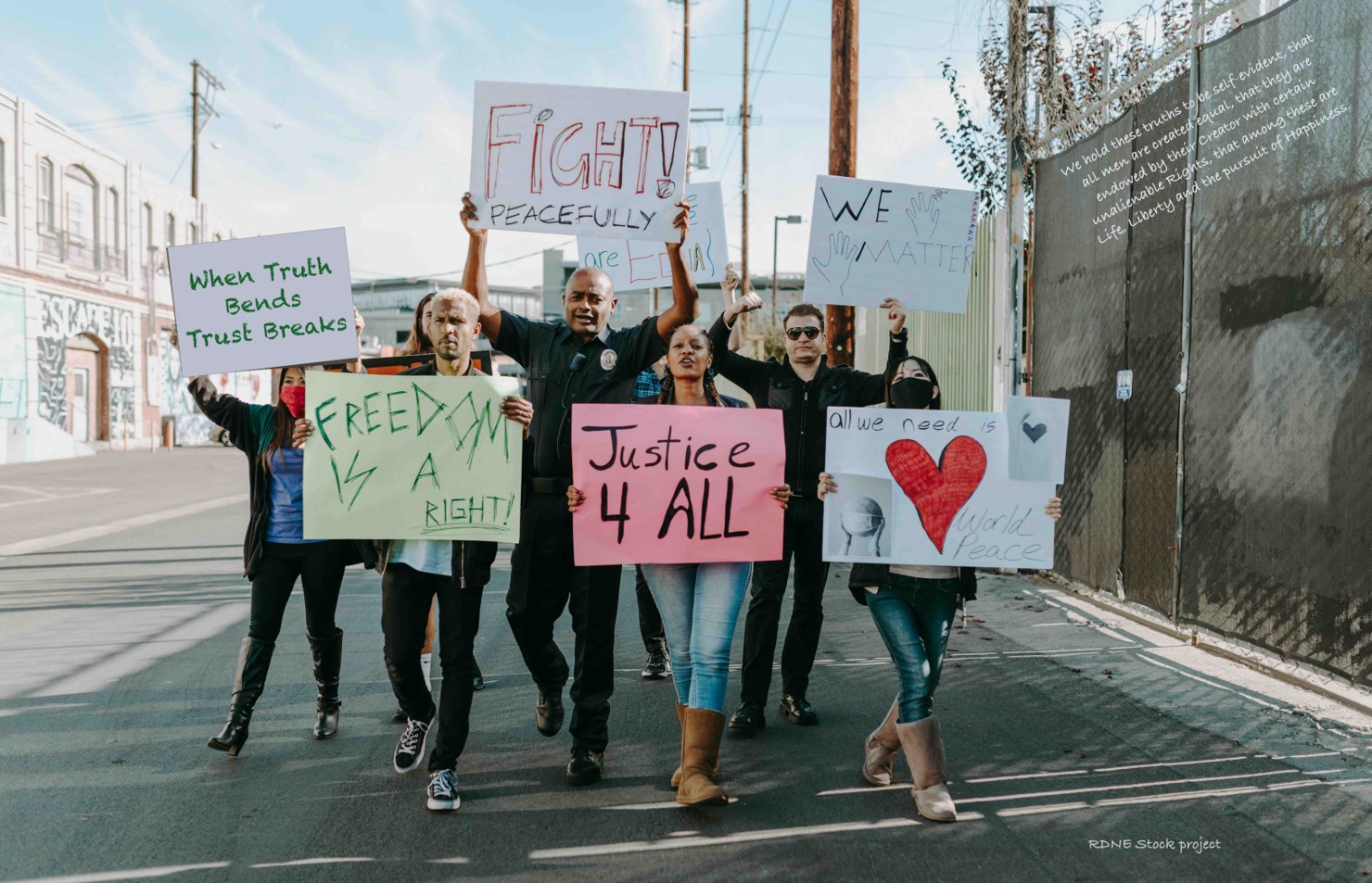
As the United States approaches its 250th anniversary, Americans are once again arguing about who we are, what we value, and whether truth itself still matters. Nevertheless, our experiment in representative democracy has been the model to which other nations strive.
Unfortunately, we are living through a moment when public trust is collapsing. Driven in large part because the truth is increasingly treated as flexible.
Facts are dismissed as inconvenient. Conspiracy theories spread faster than wisdom. Cruelty is rewarded as strength. Neighbors become enemies. Fear becomes a political strategy.
Sadly, too often, the language of faith is twisted into a tool for power, exclusion, and control. And we’re often watching this happen publicly in the name of Jesus.
The bending of the truth for personal gain by those in authority is not new. The prophet Isaiah described a similar moment long ago: “Truth stumbles in the public square, and honesty finds no place” (Isaiah 59:14).
This summer at Asbury, we invite you to join us for a new worship series called Truth. Over six weeks, we will explore some of the deepest questions facing our nation, our communities, and our faith:
What happens when people stop trusting one another?
What does Scripture say about truth in an age of manipulation and outrage?
What becomes of a society that proclaims equality while practicing exclusion?
What could happen if we allow Christian nationalism to replace neighborly love?
How do followers of Jesus remain faithful when political movements demand unquestioning loyalty?
This series is inspired in part by Walter Isaacson’s latest book, The Greatest Sentence Ever Written. In his book, Issacson reflects on the enduring and often controversial words of the Declaration of Independence: “We hold these truths to be self-evident, that all men are created equal…”
Those words have inspired generations. They have also been ignored, distorted, and denied throughout much of our history. And “these truths” are, once again, under attack.
This tension is not new.
When Jesus stood before Pilate, a political leader more concerned with preserving power than pursuing truth, Jesus declared that He came to speak about truth. And Pilate responded with a question that still echoes today: “What is truth?” (John 18:37-38).
We continue to live with the consequences of that question.
What is new is how openly deception, grievance, and the pursuit of power have begun reshaping public life — often with religious language wrapped around them. The result is a culture that is growing more cynical, more divided, and less capable of recognizing the truth when it appears.
When truth bends, trust breaks.
And when trust breaks, communities fracture. Democracies weaken. Churches lose credibility. Human beings made in the image of God become easier to dismiss, fear, or dehumanize.
Yet Scripture points us toward another way.
No more lies, then! Each of you must tell the truth to the other believer, because we are all members together in the body of Christ.
Ephesians 4:25
The prophet Zechariah writes: “Speak the truth to one another, render in your gates judgments that are true and make for peace” (Zechariah 8:16).
And perhaps that work begins with a simple but difficult commitment: “No more lies, then! Each of you must tell the truth to the other believer, because we are all members together in the body of Christ.”
(Ephesians 4:25).
Scripture calls people of faith in another direction.
Jesus did not call his followers to dominate culture. He called them to embody truth through humility, courage, mercy, justice, repentance, and love of neighbor. In a world filled with noise, distortion, and outrage, Christians are called to become trustworthy people again.
This series will not ask whether America was ever perfect. It wasn’t. Nor will it pretend our divisions are simple.
Instead, we will ask harder questions: What truths are worth holding onto? What kind of people are we becoming? And what does faithfulness require from us now?
We hope you will join us this summer for Truth.
From the Sunday following Memorial Day until the Sunday after our celebration of 250 years since the signing of the Declaration of Independence, we’ll celebrate our mutual anniversary by looking at the truth of what is arguably the “greatest sentence ever written.”
| Episode | Sunday | Title | Scripture |
|---|---|---|---|
| One | May 31 | Us | 1 Corinthians 12:12–27 |
| Two | June 7 | Evident | John 18:37–38 |
| Three | June 14 | Equal | James 2:1–9 |
| Four | June 21 | Dignity | Acts 17:22–28 |
| Five | June 28 | Pursuit | John 10:10 |
| Six | July 5 | Together | Ephesians 2:14–22 |
Please join us each Sunday at 10:30 a.m. We share our weekly episodes on Facebook and our YouTube channel, and go live at 10:30 a.m. You can find these links and more information about us, or join our live broadcast on our website, FlintAsburyChurch.org.
Pastor Tommy
The series concept and some content come from: Walter Isaacson. The Greatest Sentence Ever Written. NY: Simon & Schuster, 2025.